Tuesday, July 23, 2013
Rome, April 2013
Spring and summer have been busy so far. We have visited multiple places with many guests and family. It has been fantastic, but now it is time for me to catch my breath and start writing about it. We visited Rome in April 2013. I usually bring a step counter to see how far we go each day, and then I convert the steps into extra food and beverage! Luckily, I was able to eat and drink the equivalent of 2 extra meals per day! We averaged 11 miles a day for the 3 and a half days we were there. That is quite a bit of pasta! Good thing there was plenty of it.
Rome wasn’t built in a day, and I feel that we barely scratched the surface in the 3 ½ days we were there. Also we had been suffering from a cold rainy spring in the south of France, so we chose to spend as much time outdoors in the glorious spring weather. Generally, we will start out with a few daily destinations and a tourist map from the hotel. My goal is to see every 3 dimensional drawing on the tourist map. I believe we covered about 80% of the “pop-ups” on our map. Our hotel was centrally located and fairly close to a metro station. Rome has 2 metro lines that can take you to Vatican City and the train station, but in general the metro does not cover the area we wanted to see; hence the 11 miles a day.
Archeological evidence shows human activity in the area of Rome as far back as 14,000 years ago. Historically, Rome is said to have been founded in 753 BC. Myths and legends are many, but the most popular is about Romulus and Remus, twins who were raised by a she-wolf., regardless it is considered the birthplace of western civilization. It has been the capitol of the Roman Kingdom, the Roman Republic and the Roman Empire. Since the 1st century, Rome has been the seat of the papacy. St. Peter was the first bishop of Rome and the papal lineage for the Roman Catholic Church starts with St. Peter.
Rome has been an important city since early times. At its high point the Roman Empire covered 6.5 million square kilometers, as far north as present day Great Britain and both sides of the Mediterranean Sea. The decline of the Roman Empire begins after the 1st century AD, but it remains the capitol and an important medieval city. Rome remains the capitol until the 15th century when Florence becomes the capitol. The status of capitol goes back and forth between these 2 cities until after the Franco-Prussian War, when Rome becomes and remains the capitol.
The visible history of Rome goes back to the early Roman times around the Coliseum, Palatine and the Circus of Maximus. This area covers a vast portion of land. Over the years following the decline of the Empire, these buildings were deconstructed for their building materials and reused in the next generation of buildings. Medieval Rome saw the construction of many churches and other buildings It is estimated that there are 900 churches in Rome. Renaissance and Baroque Rome added the principal piazzas and fountains. Fountains have been an integral part of Rome early on; all fountains were connected to 2 aqueducts in the event that one was being repaired. The fountains built in the 17th and 18th centuries were constructed to be “a visual representation of confidence and power”. Staying near the Fountain of Trevi, we threw in our coins in to the fountain more than once to assure multiple return visits!
Rome is one of the most important tourist destinations in the world. It is the 3rd most visited city in Europe and hosts up to 10 million visitors a year. More if it is a holy year, or perhaps this year with the election of a new Pope. We looked for him, but only were able to see a video picture of him. On our visit to the Vatican, we somehow were able to avoid huge crowds. There are options to purchase tickets ahead of time, which we did. Also there are 2 paths through to the Sistine Chapel and we happened to take the route that the tour groups did not favor. So we were able to photograph the Spiral Ramp without anyone on it!
I did mention how much we walked? So let me tell you how I made up for it! Everyone has their favorite Italian dish, so we tried to sample all of them from seafood, to veal, to artichokes and gnocchi. The popes knew how to eat, and historically they had the best chefs in the world. Bartolomeo Scappi , chef to Pope Pius IV published a cookbook called Opera del’arte del Cucinare. It is out of print; otherwise I might have gotten a copy. If you are interested, The Philosopher’s Kitchen by Francine Segan is a well research cookbook of ancient Greece and Rome with recipes adapted to today. There quotes from the ancient scholars that are hilarious and true: “it is a hard matter, my fellow citizens to argue with the belly, since it has no ears.” Cato the Elder, 234-149 BC. And “there are two liquids especially agreeable to the human body, wine on the inside and oil outside.” Pliny the Elder 23-79 AD.
Ciao Rome, we’ll be back!
Rome wasn’t built in a day, and I feel that we barely scratched the surface in the 3 ½ days we were there. Also we had been suffering from a cold rainy spring in the south of France, so we chose to spend as much time outdoors in the glorious spring weather. Generally, we will start out with a few daily destinations and a tourist map from the hotel. My goal is to see every 3 dimensional drawing on the tourist map. I believe we covered about 80% of the “pop-ups” on our map. Our hotel was centrally located and fairly close to a metro station. Rome has 2 metro lines that can take you to Vatican City and the train station, but in general the metro does not cover the area we wanted to see; hence the 11 miles a day.
Archeological evidence shows human activity in the area of Rome as far back as 14,000 years ago. Historically, Rome is said to have been founded in 753 BC. Myths and legends are many, but the most popular is about Romulus and Remus, twins who were raised by a she-wolf., regardless it is considered the birthplace of western civilization. It has been the capitol of the Roman Kingdom, the Roman Republic and the Roman Empire. Since the 1st century, Rome has been the seat of the papacy. St. Peter was the first bishop of Rome and the papal lineage for the Roman Catholic Church starts with St. Peter.
Rome has been an important city since early times. At its high point the Roman Empire covered 6.5 million square kilometers, as far north as present day Great Britain and both sides of the Mediterranean Sea. The decline of the Roman Empire begins after the 1st century AD, but it remains the capitol and an important medieval city. Rome remains the capitol until the 15th century when Florence becomes the capitol. The status of capitol goes back and forth between these 2 cities until after the Franco-Prussian War, when Rome becomes and remains the capitol.
The visible history of Rome goes back to the early Roman times around the Coliseum, Palatine and the Circus of Maximus. This area covers a vast portion of land. Over the years following the decline of the Empire, these buildings were deconstructed for their building materials and reused in the next generation of buildings. Medieval Rome saw the construction of many churches and other buildings It is estimated that there are 900 churches in Rome. Renaissance and Baroque Rome added the principal piazzas and fountains. Fountains have been an integral part of Rome early on; all fountains were connected to 2 aqueducts in the event that one was being repaired. The fountains built in the 17th and 18th centuries were constructed to be “a visual representation of confidence and power”. Staying near the Fountain of Trevi, we threw in our coins in to the fountain more than once to assure multiple return visits!
Rome is one of the most important tourist destinations in the world. It is the 3rd most visited city in Europe and hosts up to 10 million visitors a year. More if it is a holy year, or perhaps this year with the election of a new Pope. We looked for him, but only were able to see a video picture of him. On our visit to the Vatican, we somehow were able to avoid huge crowds. There are options to purchase tickets ahead of time, which we did. Also there are 2 paths through to the Sistine Chapel and we happened to take the route that the tour groups did not favor. So we were able to photograph the Spiral Ramp without anyone on it!
I did mention how much we walked? So let me tell you how I made up for it! Everyone has their favorite Italian dish, so we tried to sample all of them from seafood, to veal, to artichokes and gnocchi. The popes knew how to eat, and historically they had the best chefs in the world. Bartolomeo Scappi , chef to Pope Pius IV published a cookbook called Opera del’arte del Cucinare. It is out of print; otherwise I might have gotten a copy. If you are interested, The Philosopher’s Kitchen by Francine Segan is a well research cookbook of ancient Greece and Rome with recipes adapted to today. There quotes from the ancient scholars that are hilarious and true: “it is a hard matter, my fellow citizens to argue with the belly, since it has no ears.” Cato the Elder, 234-149 BC. And “there are two liquids especially agreeable to the human body, wine on the inside and oil outside.” Pliny the Elder 23-79 AD.
Ciao Rome, we’ll be back!
Tuesday, May 14, 2013
St. Bertrand-de-Comminges
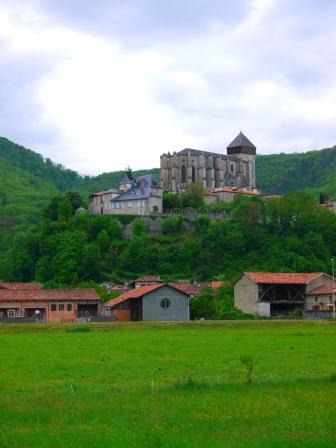
St. Bertrand-de-Comminges is a tiny walled village in the Pyrenees with ramparts and intact gates. The Roman General Pompey settled the town in 72 BC while on his way back from victories in Spain. At the height of Roman times as many as 30,000 people lived in the area. In 409 AD, the Vandals conquered and devastated the lower part of the town. The remaining residents moved into the upper part of the village. At this time they began to build a cathedral, however most of the population eventually abandons the town and it is mostly empty until 1073. Bertrand De l’Isle, a member of a wealthy family of Gascony and a member of the St. Augustine Monastery of Toulouse was named bishop of this remote diocese called Comminges. Bertrand was zealous about building and creating a great cathedral for this area, so he initiates the building of a new cathedral and cloister over the existing ruins. At that time, pilgrims on their way to Compostela Spain pass through the area, so the cathedral is built to accommodate them.
In 1218, Bertrand was made a saint and the town is renamed to St. Bertrand-de-Comminges. His tomb is in the cathedral and thus adding to the attractions for the pilgrims. And so they came. So many pass through that in 1294 the cathedral is enlarged and finally completed in 1555. Due to the remoteness of the location, the cathedral is generally left alone during the French Revolution and is remarkably intact. The cathedral is UNESCO World Heritage Site as well as an official stop on the French Route of St. Jaques de Compostela pilgrimage. The cloister dates back to the 12th century, and the bell tower was also used as a military storage facility during the Middle Ages. Inside, there are 66 choir stalls enclosed in a “Jube” style church. The “Jube” design keeps the monks separated from the rest of the population during the services. The choir is a wonderful example of medieval wood work in pristine condition. The many of the oak carvings and figures are quite amusing.
The organ is a rare construction of an elevated corner cabinet, and is considered the “Third Wonder of Gascony”. A local, famous architect and sculptor Nicholas Bachelier designed both the choir and the organ. He is also well known in Toulouse for designing the Assezat Hotel, one of the most famous stately homes in the city. I can see the tower of the Assezat Hotel from my living room window. The organ was built on 5 fluted Corinthian pillars and elevated into the corner due to a lack of space in the cathedral. The cabinet panels tell the story of the labors of Hercules. The organ has undergone 3 major renovations, the most recent in 1974. It currently has 40 stops, 3 manuals and pedals. Every summer there is an internationally renowned music festival which features this organ.
The town itself has many artisans working and is famous for hand painted umbrellas, wood works and other artisanal objects. It is a destination worth going to if not for a pilgrimage, then at least for the view, several whimsical sculptures and to see a fabulous example of a medieval cathedral.
In 1218, Bertrand was made a saint and the town is renamed to St. Bertrand-de-Comminges. His tomb is in the cathedral and thus adding to the attractions for the pilgrims. And so they came. So many pass through that in 1294 the cathedral is enlarged and finally completed in 1555. Due to the remoteness of the location, the cathedral is generally left alone during the French Revolution and is remarkably intact. The cathedral is UNESCO World Heritage Site as well as an official stop on the French Route of St. Jaques de Compostela pilgrimage. The cloister dates back to the 12th century, and the bell tower was also used as a military storage facility during the Middle Ages. Inside, there are 66 choir stalls enclosed in a “Jube” style church. The “Jube” design keeps the monks separated from the rest of the population during the services. The choir is a wonderful example of medieval wood work in pristine condition. The many of the oak carvings and figures are quite amusing.
The organ is a rare construction of an elevated corner cabinet, and is considered the “Third Wonder of Gascony”. A local, famous architect and sculptor Nicholas Bachelier designed both the choir and the organ. He is also well known in Toulouse for designing the Assezat Hotel, one of the most famous stately homes in the city. I can see the tower of the Assezat Hotel from my living room window. The organ was built on 5 fluted Corinthian pillars and elevated into the corner due to a lack of space in the cathedral. The cabinet panels tell the story of the labors of Hercules. The organ has undergone 3 major renovations, the most recent in 1974. It currently has 40 stops, 3 manuals and pedals. Every summer there is an internationally renowned music festival which features this organ.
The town itself has many artisans working and is famous for hand painted umbrellas, wood works and other artisanal objects. It is a destination worth going to if not for a pilgrimage, then at least for the view, several whimsical sculptures and to see a fabulous example of a medieval cathedral.
Friday, April 19, 2013
Cahors France April 2013
Malbec World Day this year was on April 17th. It just so happened to be the day I went to visit Cahors France. Cahors on the isthmus of the Lot River is the capitol of the Lot department in Southwestern France. Today it is best known for the grapes grown in the region: the Cot, more commonly known as Malbec. Today there are 4200 hectares in the AOC of Cahors. The history of wine in this region dates back to 50 BC following the Roman conquest of the Celts. Wine lovers that the Romans were, they planted the area with vineyards. In Medieval times the wine of this region became known as the Black Wine of Lot. Pope John XXII was born in Cahors in 1249 and while he was Pope, he made Cahors wine the official table and sacramental wine of the Roman Catholic Church. The popes of his time did not live in Rome, rather Avignon. The “Avignon Popes” were known as great lovers of wine, John XXII did much to advance the viticulture of the area and the wines of the region became known as “Vin du Pape” which later became known as Chateauneuf-du-Pape. Pope John XXII built the famous chateau that is the symbol for the wines of this AOC: Chateauneuf-du-Pape.
Emperor Peter I of Russia drank Cahors wine as well, and it became the sacramental wine of the Russian Orthodox Church. Other famous drinkers of this wine were Henry I of England; his wife was Eleanor of Aquitaine who brought this wine with her for their wedding. Black wine from Lot became a rival to the wines of Bordeaux at the English courts. In 1853 Domingo Faustino Sarmiento of Argentina was determined to improve the wine regions of his country. He hired Michel Aime Pouget a French soil specialist to make enhancements to the vineyards of Argentina. Pouget brings several types of vines from France, one being the Cot of Cahors. This vine does well and is now the dominant varietal in Argentina.
The Cot of Cahors does not fare as well in France: in 1883-1885 the Great French Wine Blight hits the region, and all of the vineyards were replanted. More recently, heavy frosts occurred in 1956 and the region had to be replanted en mass. In 1971 the region achieves the distinction of and AOC. The wines produced from Cahors are generally 100% Cot, and cannot go below 70% Cot. The other 30% is a blend of Merlot and Tannat.
Cahors was a prominent city in the Middle Ages. It was known for the fact that bankers charged interest on loans, which was considered the sin of usury by the Roman Catholic Church. Because of this, Cahors is immortalized in Dante’s Inferno as a wicked place. Today, it is primarily a tourist destination as it has a well preserved medieval section, including the Cathedral of St. Etienne and a beautiful ancient bridge the Valentre.
Cathedral of St. Etienne was built as a fortress by the bishop in the end of the 11th century. The door on the north door was carved in about 1135 and depicts the Ascension of Christ. Another small panel on the door shows the stoning of Saint Etienne in remarkable detail. The cathedral is unique in its double domed architecture and it also has a beautiful cloister dating back to 1509.
The Valentre Bridge was begun in 1308 and completed in 1378. The architect of the bridge was upset with the slow progress on the bridge. Legend has it that he made a pact with the devil to speed up the work. As the bridge rapidly approached completion, the architect found a way to get out of the agreement; he gave the devil a sieve and commanded he bring water to the workers. The devil realized he’d been bested, so every night he took out the top stone of the central tower. In 1879 during bridge renovation, the architect added a small carved statue of the devil clinging to the top of the tower as a permanent memory of the legend.
One cannot drink the wine of the region without considering the food. The regional cuisine is noted for its many duck dishes, truffles, foie gras and saffron. In addition, fruits and nuts are abundantly grown including peaches, plums, strawberries, melons and grapes. Chestnuts and walnuts are plentiful, appearing in cakes, pastries, salads and many other dishes. The food is simple, traditional and wonderful to enjoy with a glass of wine. I think it’s time for lunch!
Emperor Peter I of Russia drank Cahors wine as well, and it became the sacramental wine of the Russian Orthodox Church. Other famous drinkers of this wine were Henry I of England; his wife was Eleanor of Aquitaine who brought this wine with her for their wedding. Black wine from Lot became a rival to the wines of Bordeaux at the English courts. In 1853 Domingo Faustino Sarmiento of Argentina was determined to improve the wine regions of his country. He hired Michel Aime Pouget a French soil specialist to make enhancements to the vineyards of Argentina. Pouget brings several types of vines from France, one being the Cot of Cahors. This vine does well and is now the dominant varietal in Argentina.
The Cot of Cahors does not fare as well in France: in 1883-1885 the Great French Wine Blight hits the region, and all of the vineyards were replanted. More recently, heavy frosts occurred in 1956 and the region had to be replanted en mass. In 1971 the region achieves the distinction of and AOC. The wines produced from Cahors are generally 100% Cot, and cannot go below 70% Cot. The other 30% is a blend of Merlot and Tannat.
Cahors was a prominent city in the Middle Ages. It was known for the fact that bankers charged interest on loans, which was considered the sin of usury by the Roman Catholic Church. Because of this, Cahors is immortalized in Dante’s Inferno as a wicked place. Today, it is primarily a tourist destination as it has a well preserved medieval section, including the Cathedral of St. Etienne and a beautiful ancient bridge the Valentre.
Cathedral of St. Etienne was built as a fortress by the bishop in the end of the 11th century. The door on the north door was carved in about 1135 and depicts the Ascension of Christ. Another small panel on the door shows the stoning of Saint Etienne in remarkable detail. The cathedral is unique in its double domed architecture and it also has a beautiful cloister dating back to 1509.
The Valentre Bridge was begun in 1308 and completed in 1378. The architect of the bridge was upset with the slow progress on the bridge. Legend has it that he made a pact with the devil to speed up the work. As the bridge rapidly approached completion, the architect found a way to get out of the agreement; he gave the devil a sieve and commanded he bring water to the workers. The devil realized he’d been bested, so every night he took out the top stone of the central tower. In 1879 during bridge renovation, the architect added a small carved statue of the devil clinging to the top of the tower as a permanent memory of the legend.
One cannot drink the wine of the region without considering the food. The regional cuisine is noted for its many duck dishes, truffles, foie gras and saffron. In addition, fruits and nuts are abundantly grown including peaches, plums, strawberries, melons and grapes. Chestnuts and walnuts are plentiful, appearing in cakes, pastries, salads and many other dishes. The food is simple, traditional and wonderful to enjoy with a glass of wine. I think it’s time for lunch!
Saturday, April 6, 2013
Subscribe to:
Posts (Atom)