B is for Belgium, B is for beer. There are over 175 breweries in Belgium putting out numerous types of beer. The number one beer in the world which also happens to be the rarest beer in the world is found in Westvleteren Belgium. So, of course we had to get some! What is this beer and how do you get it? The beer is called Westvleteren and is brewed in small quantities by the Cistercian (Trappist) monks of Sint Sixtus Abbey which was founded in 1038. They brew beer in order to meet the expenses of the abbey, no more beer than that is made. In order to get the beer you can do one of two things: visit the abbey on Mondays to Thursdays or Saturday to go the beer shop. There they offer small quantities of beer for sale, when it is gone, it’s gone- the shop closes for the day! Or you can call and make a reservation to pick up a maximum of two cases of beer. Now, that appears to be a simple means to get the product, however, everyone wants this beer and everyone is trying to make the call. I called and got a busy signal, so I kept at it for over three hours. Later I found out that only one person out of twenty actually gets through to make the reservation. So off we went to Westvleteren to rendezvous with the monks. Once there, we kept our appointment and picked up the 2 cases of Westvleteren 12s. The shop was open as well, so we also purchased a few additional styles of the beer. Westvleteren makes a 6%, an 8% and a 12% beer, we are missing the 8’s!
So once we had beer in trunk, we were able to relax and enjoy the rest of the weekend. Well, what to do? We decided to stay in an area of Belgium called Poperinge right across the border with France. Watou is a small town located there. Watou happens to be the home of St. Bernardus Brewery. This brewery shares a history with Sint Sixtus. Following WWII Sint Sixtus was looking for a partner to assist with the commercialization of their beer. There was a cheese factory nearby which was founded in the 19th century by monks who left France due to the French Revolution. The French monks had since returned to France and left the cheese factory to Evarist Decoinck to continue making cheese. The monks from Sint Sixtus brought the brewmaster, the recipes and yeast strain from Westvlereten to the cheese factory to start up production. These beers were sold as Trappist Westvlereten, St. Sixtus and Sixtus. For the next 46 years this was the way they brewed, the monks brewed at the monastery to meet their needs and the commercial end was in Watou. In 1992, Belgian beer laws changed to require that the name “Trappist beer” was reserved for those beers that are brewed in a monastery by monks. So the name of the beer in Watou was changed to St. Bernardus, but all else remained the same: the recipes and the yeast. St. Bernardus offers tours in English on Saturdays, which includes a tour of the brewery, warehouse, hop fields and tasting room.
Another highlight of the trip was a visit to the De Struise Browers in Oostvleteren, not far away. This brewery started as an ostrich farm with visitors. The farmers wanted to serve regional beer to their guests, so they began making their own. They rapidly became a microbrewery. Their name is a slang term for ostrich which also happens to mean tough. They feature ostriches on many labels. Currently, many of their beers have been rated in the top 20 beers of the world, and they are in second place to their neighbors, the Sint Sixtus monks! In addition to producing their own beers, the De Struise Browers have collaborated with other microbrewers such as Mikkellers in Denmark-a blog posting to come will be about a trip to Copenhagen.
So a day full of beer touring leaves one with a big appetite! Luckily Watou is home to a Michelin Starred chef and we were able to make a reservation. Chef Stefaan Couttenye the founder of “Cuisine a la Biere” is the first chef to combine beer in cooking and pairing beer to the menu. The restaurant is cozy and comfortable, yet refined enough to reflect the cuisine. We opted for the seasonal tasting menu. Since it was spring in Belgium, there was plenty of asparagus on the menu. The first course featured a lobster terrine with green and white asparagus and marinated asparagus in kriek. My favorite course came next, a stew of eel in a green herb sauce with cream and Belgian Triple, with asparagus. The 3rd course was lamb roasted in a dark abbey beer accompanied by …. Yes…asparagus! The final course was without asparagus, but not without beer, a dessert of chef’s choice. What an end to a perfect day!
But no trip to Belgium is complete without a visit to Bruges! I love Bruges and so do many others. We went on a sunny Sunday to do a little sightseeing. Bruges is the largest city in West Flanders with over 250,000 in the metropolitan area. What most people come to see it the old city. Romans first built a fortified city in the first century BC, and now what remains are the walls, buildings and canals that were built after the charter of 1128. Bruges was a strategic location for northern and southern European trade. The main trade through the region was cloth, and then later woolen mills started along with weaving, lace and huge trade markets. The volume of trade was large and a great deal of money was exchanged and hence the first Stock Exchange was set up here. All was going great, until the river started silting up and there was no way to get the large ships into the port. So the decline came in the late 1500s. Bruges revival came as the first tourist destination in the second half of the 19th century. Tourists came to marvel at the intact medieval city complete with canals. The city has many things going for it, from a 13th century belfry, one of the tallest brick towers in the world, relics of the blood of Christ brought back by Thierry of Alsace after the 2nd Crusade, sculptures by Michelangelo and a large collection of Flemish Primitive paintings. Come for the art, the architecture, the chocolate or the food and beer. Bruges is delightful, picturesque and completely magical. I’ll be returning soon.
Thursday, August 1, 2013

Thursday, July 25, 2013
Rioja Region of Spain, Photos May 2014
San Sebastian, Spain

Rioja winery

My sister the pilgrim

Pamplona, Spain

Laguardia, Spain

Wine cellars in Laguardia

View from Laguardia

Muga Bodega

Heredia Bodega

La Rioja Bodega

La Rioja Bodega

Gomez Cruzado Bodega

Hotel Marques de Riscal

Rioja Region of Spain, May 2014
All of the eastern part of Spain is located within a few hours’ drive of Toulouse France. During the month of May, the French enjoy several holidays, so why not take a few days to explore nearby Spain? And so we did. After a quick stop in the rain in Biarritz France for the plat de jour for lunch (a delicious lamb dish) we crossed the border into Spain. Our first destination was San Sebastian, a lovely beach resort. The city has been a beach destination since the late 19th century. In the old town there are many a tapas bar and restaurants and fabulous cathedrals and government buildings. High above town there is the Castillo de Santa Cruz de la Mota, an old ruin of a castle and fort. It offers some of the best views of the beach and surrounding area. The restaurant where we had dinner was the oldest restaurant directly on the beach built in an Art Deco style. We stayed for a night in San Sebastian before heading on to the real destination: The Rioja, a famous Spanish wine region.
The Rioja is located in north central Spain south of the Catabrian Mountains along the Ebro River. This is subdivided into three areas:
Rioja Alta: higher altitude, shorter season, lighter old world styles of wine
Rioja Baja: hot climate, deep colored, higher alcohol content, up to 18% ETOH, used primarily for blending
Rioja Alavesa: full bodied, high acidity, poor soil so fields have low vine density
Wine making is a tradition in the area, dating back to the Roman times. During the middle ages monks were in charge of the whole wine making process. In 1635 the mayor of Logrono passed a law forbidding carts on streets where there were wine caves, fearing that the vibrations would upset the wines and cause them to deteriorate. This wine region has set standards for itself since 1650 with the goal of promoting the cultivation and commercialization of Rioja wines.
Grapes varieties include, but are not limited to Tempranillo, Garnacha Tinta, Graciano and Mazuelo. The wine is aged in oak, traditionally French oak, now a bit more American oak. The Spanish bring the wooden planks in, but have a history of crafting their own barrels. The current trend is a preference for French oak made into smaller barrels, with wine spending shorter time in the barrel, but wines have to be labeled as such. The categorization of the wine depends on aging and time in the barrel.
Rioja: youngest wine spending less than a year in an oak barrel.
Crianza: aged at least two years and at least one year in an oak barrel.
Rioja Reserva: aged at least 3 years and at least one year in an oak barrel.
Rioja Gran Reserva: aged two years in oak and the three years in a bottle.
Grapes can also come from a few other areas in Navarre and the Basque region. Many wines are blends of several of these locations and varietals. Traditionally, winemakers decide when the wine is ready to be released, and sometimes they may wait a few years longer before they do. It is worth the wait. These wines range from being fruity and easy to drink to more rustic styles that can be cellared for years.
Haro Spain is a small town in the center of the Rioja region. It hosts a wine festival every year on June 29th. Everyone dresses in white, gets up early, and lugs jugs of wine with them out of the town and up the hill. After Mass, everyone starts throwing wine at each other. Everyone leaves the festival in purple clothing! Unfortunately we were early for this festival, but made up for it by trying wine at the Bodegas. These are the wineries of the major Rioja producers. They each have their tasting rooms conveniently located next to each other with well-marked paths between them. It is an easy way to try the different styles of Rioja. In the end, I had a preference for the traditional style of Lopez de Heredia.
Since you cannot spend all of your time in the bodegas, there is plenty to see in the surrounding areas. We had a day in Pamplona which was the historic capitol of Navarre. It was named for the Roman general Pompey who camped in that area during the war against Sertorius. Many have ruled this town from the Visigoths, the Muslims, and the French to name a few. During Medieval times, the town was a major stop off for pilgrims on their way to Santiago de Compostella. The pilgrims were vital to the economic development of the town and keeping communication going between the rest of Europe. Today it is still a major staging town for pilgrims crossing the Pyrenees or those who are just starting their pilgrimage. The way is marked with a symbol of the scallop shell and can be seen all throughout town and the surrounding areas. Many restaurants offer pilgrim’s menus, and high calorie, filling yet inexpensive menu. Luckily there are many shops in town to help outfit the pilgrim. Since it was raining, I was able to find a very lightweight durable umbrella in one of the shops. Pilgrims aside, what makes Pamplona most famous today is San Fernin’s Festival. This is the annual festival from July 6-14th when the bulls are let loose to run through the streets. Brave souls jump in front of the bulls and try to beat them to the arena. Not for the faint of heart, and not for me. We did follow the route and see the statue of Earnest Hemmingway whose book The Sun Also Rises brought international prominence to the festival.
Another great stop is Laguardia, a tiny walled town near the Cantabrian Mountains. Established in the 10th century as a fortress town, the residents dug caves under their houses and streets for storage in the event of siege. A little later on, these caves were converted into wine caves. Several with tours are still in continuous operation today. We toured the bell tower and our guide pointed out the town of Elciego. She said it was worth the trip. She may have said a few other things, but I have become so confused between trying to learn French and having a basic command of Spanish that I never know what I’m hearing or saying. She also mentioned that the lakes in the distance were important stops for migratory birds on their trips between Europe and Africa. So off to Elciego we went in search of something worth seeing.
What we found was a nice old town, but really she intended us to see the Hotel Marques de Riscal designed by Frank Gehry. It is a magical wonder popping out of the fields around it. The day was partly cloudy to mostly sunny, so the titanium on the building reflected the colors beautifully. With the vineyards in the background plus fields of poppies, it was stunning. We were able to walk on the grounds and through the lobby. With a price tag of 361-520 euros per night, we decided that was all we could do was take pictures and leave a few footprints! Oh yes, we might have brought a few bottles of wine home for the cellar.
Salude Rioja!
The Rioja is located in north central Spain south of the Catabrian Mountains along the Ebro River. This is subdivided into three areas:
Rioja Alta: higher altitude, shorter season, lighter old world styles of wine
Rioja Baja: hot climate, deep colored, higher alcohol content, up to 18% ETOH, used primarily for blending
Rioja Alavesa: full bodied, high acidity, poor soil so fields have low vine density
Wine making is a tradition in the area, dating back to the Roman times. During the middle ages monks were in charge of the whole wine making process. In 1635 the mayor of Logrono passed a law forbidding carts on streets where there were wine caves, fearing that the vibrations would upset the wines and cause them to deteriorate. This wine region has set standards for itself since 1650 with the goal of promoting the cultivation and commercialization of Rioja wines.
Grapes varieties include, but are not limited to Tempranillo, Garnacha Tinta, Graciano and Mazuelo. The wine is aged in oak, traditionally French oak, now a bit more American oak. The Spanish bring the wooden planks in, but have a history of crafting their own barrels. The current trend is a preference for French oak made into smaller barrels, with wine spending shorter time in the barrel, but wines have to be labeled as such. The categorization of the wine depends on aging and time in the barrel.
Rioja: youngest wine spending less than a year in an oak barrel.
Crianza: aged at least two years and at least one year in an oak barrel.
Rioja Reserva: aged at least 3 years and at least one year in an oak barrel.
Rioja Gran Reserva: aged two years in oak and the three years in a bottle.
Grapes can also come from a few other areas in Navarre and the Basque region. Many wines are blends of several of these locations and varietals. Traditionally, winemakers decide when the wine is ready to be released, and sometimes they may wait a few years longer before they do. It is worth the wait. These wines range from being fruity and easy to drink to more rustic styles that can be cellared for years.
Haro Spain is a small town in the center of the Rioja region. It hosts a wine festival every year on June 29th. Everyone dresses in white, gets up early, and lugs jugs of wine with them out of the town and up the hill. After Mass, everyone starts throwing wine at each other. Everyone leaves the festival in purple clothing! Unfortunately we were early for this festival, but made up for it by trying wine at the Bodegas. These are the wineries of the major Rioja producers. They each have their tasting rooms conveniently located next to each other with well-marked paths between them. It is an easy way to try the different styles of Rioja. In the end, I had a preference for the traditional style of Lopez de Heredia.
Since you cannot spend all of your time in the bodegas, there is plenty to see in the surrounding areas. We had a day in Pamplona which was the historic capitol of Navarre. It was named for the Roman general Pompey who camped in that area during the war against Sertorius. Many have ruled this town from the Visigoths, the Muslims, and the French to name a few. During Medieval times, the town was a major stop off for pilgrims on their way to Santiago de Compostella. The pilgrims were vital to the economic development of the town and keeping communication going between the rest of Europe. Today it is still a major staging town for pilgrims crossing the Pyrenees or those who are just starting their pilgrimage. The way is marked with a symbol of the scallop shell and can be seen all throughout town and the surrounding areas. Many restaurants offer pilgrim’s menus, and high calorie, filling yet inexpensive menu. Luckily there are many shops in town to help outfit the pilgrim. Since it was raining, I was able to find a very lightweight durable umbrella in one of the shops. Pilgrims aside, what makes Pamplona most famous today is San Fernin’s Festival. This is the annual festival from July 6-14th when the bulls are let loose to run through the streets. Brave souls jump in front of the bulls and try to beat them to the arena. Not for the faint of heart, and not for me. We did follow the route and see the statue of Earnest Hemmingway whose book The Sun Also Rises brought international prominence to the festival.
Another great stop is Laguardia, a tiny walled town near the Cantabrian Mountains. Established in the 10th century as a fortress town, the residents dug caves under their houses and streets for storage in the event of siege. A little later on, these caves were converted into wine caves. Several with tours are still in continuous operation today. We toured the bell tower and our guide pointed out the town of Elciego. She said it was worth the trip. She may have said a few other things, but I have become so confused between trying to learn French and having a basic command of Spanish that I never know what I’m hearing or saying. She also mentioned that the lakes in the distance were important stops for migratory birds on their trips between Europe and Africa. So off to Elciego we went in search of something worth seeing.
What we found was a nice old town, but really she intended us to see the Hotel Marques de Riscal designed by Frank Gehry. It is a magical wonder popping out of the fields around it. The day was partly cloudy to mostly sunny, so the titanium on the building reflected the colors beautifully. With the vineyards in the background plus fields of poppies, it was stunning. We were able to walk on the grounds and through the lobby. With a price tag of 361-520 euros per night, we decided that was all we could do was take pictures and leave a few footprints! Oh yes, we might have brought a few bottles of wine home for the cellar.
Salude Rioja!
Tuesday, July 23, 2013
Rome in Photos, April 2013
Colosseum

Arch of Constatine

Arch of Titus

In the Palentine

Pantheon

Castle Sant Angelo

Pope Francis I

Sistine Chapel

Spiral Ramp

Saint Peter's Basilica

Tiber River View

Another river view

Piazza Navona

Fountain of Trevi

Tomb of Unknown Soldier

Door to Restaurant

I'll be back!

Rome, April 2013
Spring and summer have been busy so far. We have visited multiple places with many guests and family. It has been fantastic, but now it is time for me to catch my breath and start writing about it. We visited Rome in April 2013. I usually bring a step counter to see how far we go each day, and then I convert the steps into extra food and beverage! Luckily, I was able to eat and drink the equivalent of 2 extra meals per day! We averaged 11 miles a day for the 3 and a half days we were there. That is quite a bit of pasta! Good thing there was plenty of it.
Rome wasn’t built in a day, and I feel that we barely scratched the surface in the 3 ½ days we were there. Also we had been suffering from a cold rainy spring in the south of France, so we chose to spend as much time outdoors in the glorious spring weather. Generally, we will start out with a few daily destinations and a tourist map from the hotel. My goal is to see every 3 dimensional drawing on the tourist map. I believe we covered about 80% of the “pop-ups” on our map. Our hotel was centrally located and fairly close to a metro station. Rome has 2 metro lines that can take you to Vatican City and the train station, but in general the metro does not cover the area we wanted to see; hence the 11 miles a day.
Archeological evidence shows human activity in the area of Rome as far back as 14,000 years ago. Historically, Rome is said to have been founded in 753 BC. Myths and legends are many, but the most popular is about Romulus and Remus, twins who were raised by a she-wolf., regardless it is considered the birthplace of western civilization. It has been the capitol of the Roman Kingdom, the Roman Republic and the Roman Empire. Since the 1st century, Rome has been the seat of the papacy. St. Peter was the first bishop of Rome and the papal lineage for the Roman Catholic Church starts with St. Peter.
Rome has been an important city since early times. At its high point the Roman Empire covered 6.5 million square kilometers, as far north as present day Great Britain and both sides of the Mediterranean Sea. The decline of the Roman Empire begins after the 1st century AD, but it remains the capitol and an important medieval city. Rome remains the capitol until the 15th century when Florence becomes the capitol. The status of capitol goes back and forth between these 2 cities until after the Franco-Prussian War, when Rome becomes and remains the capitol.
The visible history of Rome goes back to the early Roman times around the Coliseum, Palatine and the Circus of Maximus. This area covers a vast portion of land. Over the years following the decline of the Empire, these buildings were deconstructed for their building materials and reused in the next generation of buildings. Medieval Rome saw the construction of many churches and other buildings It is estimated that there are 900 churches in Rome. Renaissance and Baroque Rome added the principal piazzas and fountains. Fountains have been an integral part of Rome early on; all fountains were connected to 2 aqueducts in the event that one was being repaired. The fountains built in the 17th and 18th centuries were constructed to be “a visual representation of confidence and power”. Staying near the Fountain of Trevi, we threw in our coins in to the fountain more than once to assure multiple return visits!
Rome is one of the most important tourist destinations in the world. It is the 3rd most visited city in Europe and hosts up to 10 million visitors a year. More if it is a holy year, or perhaps this year with the election of a new Pope. We looked for him, but only were able to see a video picture of him. On our visit to the Vatican, we somehow were able to avoid huge crowds. There are options to purchase tickets ahead of time, which we did. Also there are 2 paths through to the Sistine Chapel and we happened to take the route that the tour groups did not favor. So we were able to photograph the Spiral Ramp without anyone on it!
I did mention how much we walked? So let me tell you how I made up for it! Everyone has their favorite Italian dish, so we tried to sample all of them from seafood, to veal, to artichokes and gnocchi. The popes knew how to eat, and historically they had the best chefs in the world. Bartolomeo Scappi , chef to Pope Pius IV published a cookbook called Opera del’arte del Cucinare. It is out of print; otherwise I might have gotten a copy. If you are interested, The Philosopher’s Kitchen by Francine Segan is a well research cookbook of ancient Greece and Rome with recipes adapted to today. There quotes from the ancient scholars that are hilarious and true: “it is a hard matter, my fellow citizens to argue with the belly, since it has no ears.” Cato the Elder, 234-149 BC. And “there are two liquids especially agreeable to the human body, wine on the inside and oil outside.” Pliny the Elder 23-79 AD.
Ciao Rome, we’ll be back!
Rome wasn’t built in a day, and I feel that we barely scratched the surface in the 3 ½ days we were there. Also we had been suffering from a cold rainy spring in the south of France, so we chose to spend as much time outdoors in the glorious spring weather. Generally, we will start out with a few daily destinations and a tourist map from the hotel. My goal is to see every 3 dimensional drawing on the tourist map. I believe we covered about 80% of the “pop-ups” on our map. Our hotel was centrally located and fairly close to a metro station. Rome has 2 metro lines that can take you to Vatican City and the train station, but in general the metro does not cover the area we wanted to see; hence the 11 miles a day.
Archeological evidence shows human activity in the area of Rome as far back as 14,000 years ago. Historically, Rome is said to have been founded in 753 BC. Myths and legends are many, but the most popular is about Romulus and Remus, twins who were raised by a she-wolf., regardless it is considered the birthplace of western civilization. It has been the capitol of the Roman Kingdom, the Roman Republic and the Roman Empire. Since the 1st century, Rome has been the seat of the papacy. St. Peter was the first bishop of Rome and the papal lineage for the Roman Catholic Church starts with St. Peter.
Rome has been an important city since early times. At its high point the Roman Empire covered 6.5 million square kilometers, as far north as present day Great Britain and both sides of the Mediterranean Sea. The decline of the Roman Empire begins after the 1st century AD, but it remains the capitol and an important medieval city. Rome remains the capitol until the 15th century when Florence becomes the capitol. The status of capitol goes back and forth between these 2 cities until after the Franco-Prussian War, when Rome becomes and remains the capitol.
The visible history of Rome goes back to the early Roman times around the Coliseum, Palatine and the Circus of Maximus. This area covers a vast portion of land. Over the years following the decline of the Empire, these buildings were deconstructed for their building materials and reused in the next generation of buildings. Medieval Rome saw the construction of many churches and other buildings It is estimated that there are 900 churches in Rome. Renaissance and Baroque Rome added the principal piazzas and fountains. Fountains have been an integral part of Rome early on; all fountains were connected to 2 aqueducts in the event that one was being repaired. The fountains built in the 17th and 18th centuries were constructed to be “a visual representation of confidence and power”. Staying near the Fountain of Trevi, we threw in our coins in to the fountain more than once to assure multiple return visits!
Rome is one of the most important tourist destinations in the world. It is the 3rd most visited city in Europe and hosts up to 10 million visitors a year. More if it is a holy year, or perhaps this year with the election of a new Pope. We looked for him, but only were able to see a video picture of him. On our visit to the Vatican, we somehow were able to avoid huge crowds. There are options to purchase tickets ahead of time, which we did. Also there are 2 paths through to the Sistine Chapel and we happened to take the route that the tour groups did not favor. So we were able to photograph the Spiral Ramp without anyone on it!
I did mention how much we walked? So let me tell you how I made up for it! Everyone has their favorite Italian dish, so we tried to sample all of them from seafood, to veal, to artichokes and gnocchi. The popes knew how to eat, and historically they had the best chefs in the world. Bartolomeo Scappi , chef to Pope Pius IV published a cookbook called Opera del’arte del Cucinare. It is out of print; otherwise I might have gotten a copy. If you are interested, The Philosopher’s Kitchen by Francine Segan is a well research cookbook of ancient Greece and Rome with recipes adapted to today. There quotes from the ancient scholars that are hilarious and true: “it is a hard matter, my fellow citizens to argue with the belly, since it has no ears.” Cato the Elder, 234-149 BC. And “there are two liquids especially agreeable to the human body, wine on the inside and oil outside.” Pliny the Elder 23-79 AD.
Ciao Rome, we’ll be back!
Tuesday, May 14, 2013
St. Bertrand-de-Comminges Photos May 2013
St. Bertrand-de-Comminges
Restaurant in village

View of street

Entrance to the cloister

Cloister pillars, 4 Evangelists

St. Bertrand's Tomb

St. Berteand's mitre

Shoes & tapistry 14th C, gloves 15th C

Fighting Figures in the choir

Siren capturing a fisherman

Back panels of the choir stalls

The 3rd Wonder of Gascony!

The rear view of the cathedral

View from Cloister

Art in the park

St. Bertrand-de-Comminges
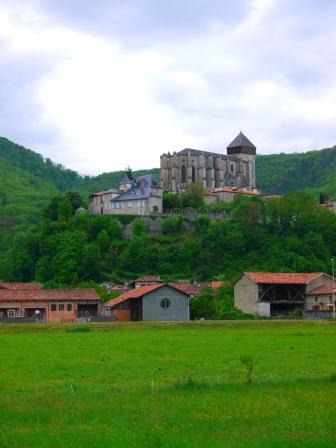
St. Bertrand-de-Comminges is a tiny walled village in the Pyrenees with ramparts and intact gates. The Roman General Pompey settled the town in 72 BC while on his way back from victories in Spain. At the height of Roman times as many as 30,000 people lived in the area. In 409 AD, the Vandals conquered and devastated the lower part of the town. The remaining residents moved into the upper part of the village. At this time they began to build a cathedral, however most of the population eventually abandons the town and it is mostly empty until 1073. Bertrand De l’Isle, a member of a wealthy family of Gascony and a member of the St. Augustine Monastery of Toulouse was named bishop of this remote diocese called Comminges. Bertrand was zealous about building and creating a great cathedral for this area, so he initiates the building of a new cathedral and cloister over the existing ruins. At that time, pilgrims on their way to Compostela Spain pass through the area, so the cathedral is built to accommodate them.
In 1218, Bertrand was made a saint and the town is renamed to St. Bertrand-de-Comminges. His tomb is in the cathedral and thus adding to the attractions for the pilgrims. And so they came. So many pass through that in 1294 the cathedral is enlarged and finally completed in 1555. Due to the remoteness of the location, the cathedral is generally left alone during the French Revolution and is remarkably intact. The cathedral is UNESCO World Heritage Site as well as an official stop on the French Route of St. Jaques de Compostela pilgrimage. The cloister dates back to the 12th century, and the bell tower was also used as a military storage facility during the Middle Ages. Inside, there are 66 choir stalls enclosed in a “Jube” style church. The “Jube” design keeps the monks separated from the rest of the population during the services. The choir is a wonderful example of medieval wood work in pristine condition. The many of the oak carvings and figures are quite amusing.
The organ is a rare construction of an elevated corner cabinet, and is considered the “Third Wonder of Gascony”. A local, famous architect and sculptor Nicholas Bachelier designed both the choir and the organ. He is also well known in Toulouse for designing the Assezat Hotel, one of the most famous stately homes in the city. I can see the tower of the Assezat Hotel from my living room window. The organ was built on 5 fluted Corinthian pillars and elevated into the corner due to a lack of space in the cathedral. The cabinet panels tell the story of the labors of Hercules. The organ has undergone 3 major renovations, the most recent in 1974. It currently has 40 stops, 3 manuals and pedals. Every summer there is an internationally renowned music festival which features this organ.
The town itself has many artisans working and is famous for hand painted umbrellas, wood works and other artisanal objects. It is a destination worth going to if not for a pilgrimage, then at least for the view, several whimsical sculptures and to see a fabulous example of a medieval cathedral.
In 1218, Bertrand was made a saint and the town is renamed to St. Bertrand-de-Comminges. His tomb is in the cathedral and thus adding to the attractions for the pilgrims. And so they came. So many pass through that in 1294 the cathedral is enlarged and finally completed in 1555. Due to the remoteness of the location, the cathedral is generally left alone during the French Revolution and is remarkably intact. The cathedral is UNESCO World Heritage Site as well as an official stop on the French Route of St. Jaques de Compostela pilgrimage. The cloister dates back to the 12th century, and the bell tower was also used as a military storage facility during the Middle Ages. Inside, there are 66 choir stalls enclosed in a “Jube” style church. The “Jube” design keeps the monks separated from the rest of the population during the services. The choir is a wonderful example of medieval wood work in pristine condition. The many of the oak carvings and figures are quite amusing.
The organ is a rare construction of an elevated corner cabinet, and is considered the “Third Wonder of Gascony”. A local, famous architect and sculptor Nicholas Bachelier designed both the choir and the organ. He is also well known in Toulouse for designing the Assezat Hotel, one of the most famous stately homes in the city. I can see the tower of the Assezat Hotel from my living room window. The organ was built on 5 fluted Corinthian pillars and elevated into the corner due to a lack of space in the cathedral. The cabinet panels tell the story of the labors of Hercules. The organ has undergone 3 major renovations, the most recent in 1974. It currently has 40 stops, 3 manuals and pedals. Every summer there is an internationally renowned music festival which features this organ.
The town itself has many artisans working and is famous for hand painted umbrellas, wood works and other artisanal objects. It is a destination worth going to if not for a pilgrimage, then at least for the view, several whimsical sculptures and to see a fabulous example of a medieval cathedral.
Subscribe to:
Posts (Atom)